


How the imai Foundation Improved Time-Based Media Cataloguing with TMS
Cataloguing Time Based Media
The City of Düsseldorf established the inter media art institute (imai Foundation) in 2006 as an archive to care for an acquired video collection. The archive contains around 3,000 works of Time Based Media art, and provides context to the history of Time Based Media from the 1970s through today. As the collection expands to include contemporary artists, imai has made protecting, conserving, and cataloguing the collection a top priority.
Challenge
In 2016, the imai Foundation launched a two-year project, funded by the Rhineland Regional Council, to preserve and catalogue their Time Based Media collection.
Cataloguing and protecting Time Based Media is a different process from cataloguing other objects, as Hiroko Kimura-Myokam, a team member of the long-term archival project, explains, “When you have one painting, you create one object record. But with Time Based Media, the materials become obsolete and degrade, and there are multiple pieces in different formats that need to be catalogued. They’re not all physical objects, and they’re not all collection objects.” The team at the imai foundation needed a plan to protect their collection and catalogue it appropriately without overly convoluted workflows.
Further complicating the project, a previous digitization effort conducted in 2003 produced archival video copies in the format of Digital Betacam Tapes and mp2-files, which have since become outdated. Hiroko says, “The reality we faced was that the archive repository and server were both full of plural tapes and files for single channel video works. These files and objects became obsolete after our second digitizing project.”
Beginning in 2016, the team worked with a digitization agency to create three new digital files for each object: an archival file, a preview file, and a “mezzanine” file, a digital master file that can be duplicated for additional viewing. After digitization, the team documented the history of the objects and both digitization projects.
Project
After building their new file repository, the team planned their cataloguing process, making a distinction between the video object and the equipment related to displaying it. Hiroko explains more about the collections objects, “imai doesn’t exhibit the objects. This meant that we only had the single- and multi-channel Time Based Media works to document, and weren’t concerned with any equipment that would be used to play the videos in the collection.”
Developing a strategy to document the Time Based Media works helped to create a system to document the entire collection, although Hiroko knew there would still be challenges, “The biggest problem was figuring out how to describe the copies and migration history in our database system.”
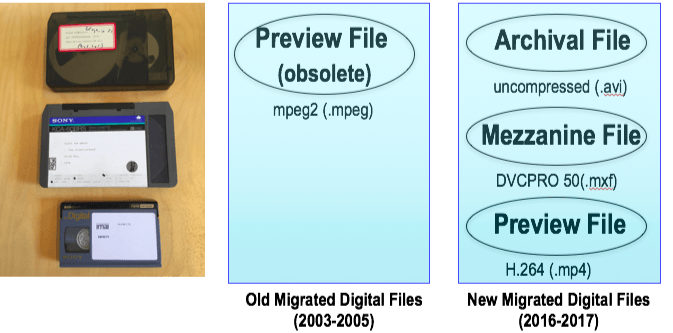
Single Channel Video Work Plural Tapes
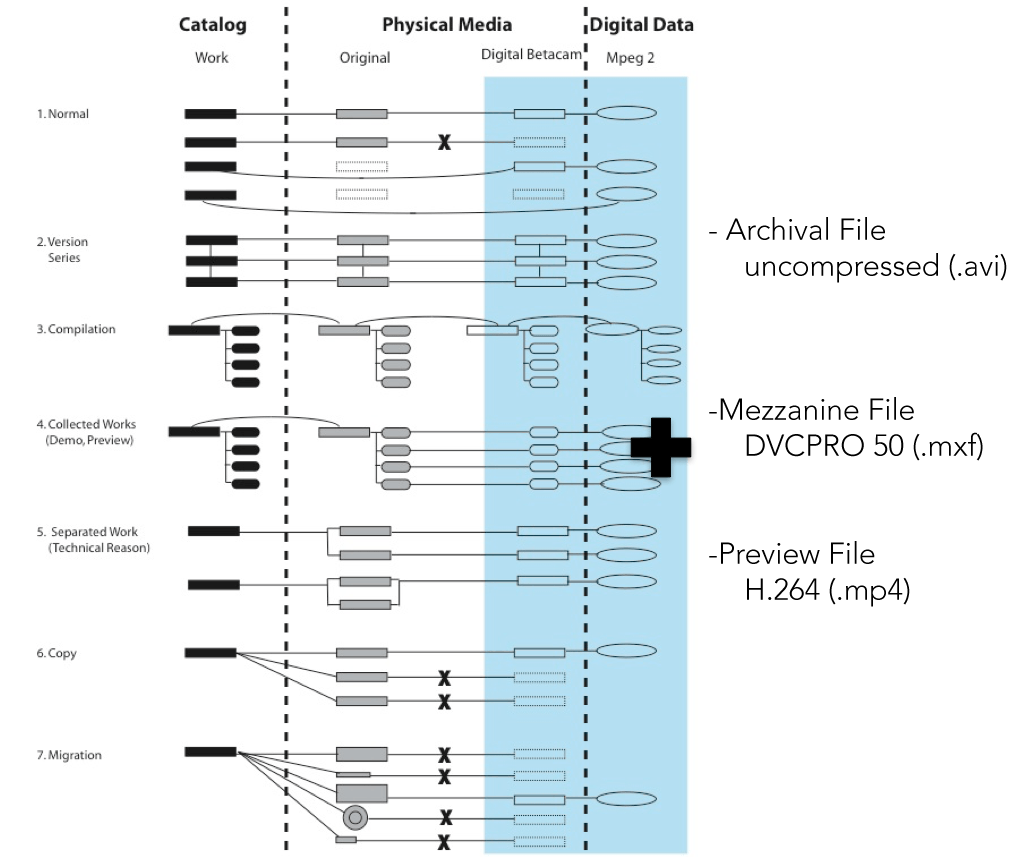
Concept Diagram of imai Database
“There’s a gap in technology between the physical and digital files, and the physical media and digital files both require their own metadata scheme. That’s why we separated the data into three different Departments,” says Hiroko. “Each piece has a different entry form and is independent but related to the other.” This is where the team relied on user-created custom forms and Flex Fields.
After careful consideration, Hiroko’s team used Departments and Flex Fields in TMS to their advantage to include exactly the information they needed for their records.
Using parent-child relationships, and ‘see-also’ links, Hiroko’s team connected object records that were related to one another, and copies or digitized versions of the original work.
Each record is defined by a Department, and the corresponding metadata structure for that Department is assigned to the object record. As each Department has different requirements for what data is entered, the Department assignment helps to automate the Flex Fields each record should have. That way, fields don’t have to be adjusted for every new record, they’re simply available when an object record is assigned a specific Department.
In addition to the objects included in their archival process, imai has also used a similar process to create relationships for multiple Time Based Media works that have a connection, such as works with multiple versions, works that are a part of a series or a trilogy, and works that are part of a compilation. Hiroko explains, “If the work is a trilogy or series, the main title and three parts are linked through the parent-child relationship, and compilation works are treated in the same way.”
When cataloguing variant works, the process is a little different. “We consider variant works such as long versions, short versions, different language, and so on, as different works,” describes Hiroko. “It can be difficult to decide which work is the main work. Therefore, variant works are linked through ‘see-also’ connections, not parent-child connections.”
Hiroko’s team and the imai foundation have worked hard to develop a system to properly archive their Time Based Media collection. Their focus to digitize and catalogue their collection is nearing completion, and Hiroko is excited to see what’s next for the team. She tells us, “The next step is to connect related archival materials with the works we’ve already catalogued in the database. This includes additional materials like still images, contracts with artists, conservation and quality check reports, and any other materials that are linked to the works.”
Hiroko’s team will focus on improving imai’s online catalogue and adding more research materials to their online platform. The team is also interested in incorporating keywords into their online platform, and elevating their use as finding aids, “We’ve added a keywords field in the Work Department, so we can export keywords to the digital catalogue,” says Hiroko. Her team hopes their work can help other museums, and potentially be used as a model to add to the broader conversation of working with Time Based Media and other complex collection pieces.
The Results
-
Created a scalable cataloguing system for more than 3,000 time-based media works
-
Improved preservation and documentation of migrated digital assets
-
Reduced storage complexity through structured management of multiple file versions
-
Improved access to collection information and online research resources

What Powered This Transformation

TMS Suite
eMuseum
More Success Stories

Why Galleries Can No Longer Wait to Modernize Their Gallery Management Software
The Art World’s Technology Reckoning Only 19% of galleries call themselves technology leaders, yet 43% plan to invest more in online sales this year, according to Artsy’s Art Market…

Collective Conversations with Chad Petrovay
Professional Services Specialist, Gallery Systems With a museum career spanning multiple institutions and over a decade partnering with Gallery Systems clients, Chad brings a rare combination of…

Why Galleries Can No Longer Wait to Modernize Their Gallery Management Software
The Art World’s Technology Reckoning Only 19% of galleries call themselves technology leaders, yet 43% plan to invest more in online sales this year, according to Artsy’s Art Market…
Collective Conversations with Chad Petrovay
Professional Services Specialist, Gallery Systems With a museum career spanning multiple institutions and over a decade partnering with Gallery Systems clients, Chad brings a rare combination of…
Why Galleries Can No Longer Wait to Modernize Their Gallery Management Software
The Art World’s Technology Reckoning Only 19% of galleries call themselves technology leaders, yet 43% plan to invest more in online sales this year, according to Artsy’s Art Market…
Collective Conversations with Chad Petrovay
Professional Services Specialist, Gallery Systems With a museum career spanning multiple institutions and over a decade partnering with Gallery Systems clients, Chad brings a rare combination of…
Why Galleries Can No Longer Wait to Modernize Their Gallery Management Software
The Art World’s Technology Reckoning Only 19% of galleries call themselves technology leaders, yet 43% plan to invest more in online sales this year, according to Artsy’s Art Market…
Collective Conversations with Chad Petrovay
Professional Services Specialist, Gallery Systems With a museum career spanning multiple institutions and over a decade partnering with Gallery Systems clients, Chad brings a rare combination of…
Why Galleries Can No Longer Wait to Modernize Their Gallery Management Software
The Art World’s Technology Reckoning Only 19% of galleries call themselves technology leaders, yet 43% plan to invest more in online sales this year, according to Artsy’s Art Market…
Collective Conversations with Chad Petrovay
Professional Services Specialist, Gallery Systems With a museum career spanning multiple institutions and over a decade partnering with Gallery Systems clients, Chad brings a rare combination of…